




Richard Deacon
(U.K.) *1949 in Bangor, Wales
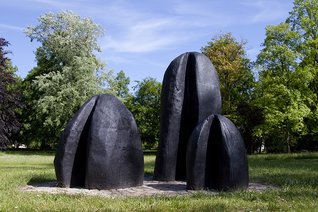
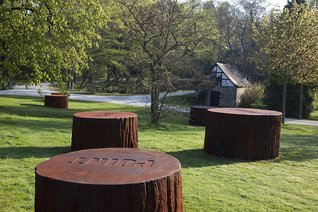
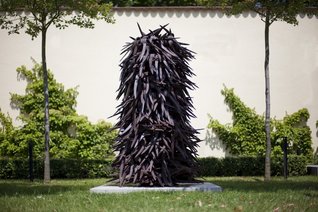
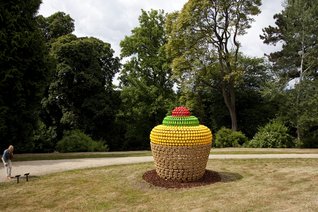
For fifty years, Richard Deacon has in different ways explored the characteristics of his materials in his sculptural work. The artist, who describes himself as a “fabricator”, creates sculptural constructs that invariably express the interplay of form and void and are thus open to the viewer’s play of associations. Two of the four works presented at Blickachsen 14 have titles that describe the artistic process: for “Cut & Fold #3” and “Cut & Fold #5”, Deacon cuts and folds stainless steel plates and joins them together to form geometric-prismatic shapes. The two elements of “Twofold Way CD (Black)” are also produced in a similar way. In contrast, the components of “Infinity #14”, each pierced by two or three holes, draw the eye especially to the diverse possibilities of surface treatment: the regular indentations glisteningly reflect the sunlight, which hits them directly due to their angled position.
Richard Deacon is one of the most important sculptors of his generation. His works can be seen in major exhibitions worldwide, including at documenta 1992, as well as in public spaces. Deacon was awarded the Turner Prize in 1987 and was professor of sculpture in Paris and Düsseldorf.
Blickachsen 9 (2013):
With an impressive consistency and readiness to experiment, Richard Deacon has since the 1970’s produced a complex body of abstract spatial constructions, for which he has already been awarded many prizes. His exploration of the most varied of working materials, and his facility in manipulating them, form the basis for his sculptural designs. His works overcome the resistance of metal, and squeeze wood into endlessly curved shapes which cut through space. “Siamese Metal #6” is part of a series in which Deacon combines two tubular steel structures so that they share features at their interface. Although bound together as a single overall structure, they remain accessible as individual forms. According to Deacon, the term “Siamese” in the title of these works refers to “the twinning process, as in a Siamese junction in pipework, and harks back to the now discredited term for conjoined twins, a naming that recalls a pair of conjoined acrobats in the nineteenth century court of the king of Siam.” Individuality and autonomy are here brought together with notions of community, intersection and exchange.